
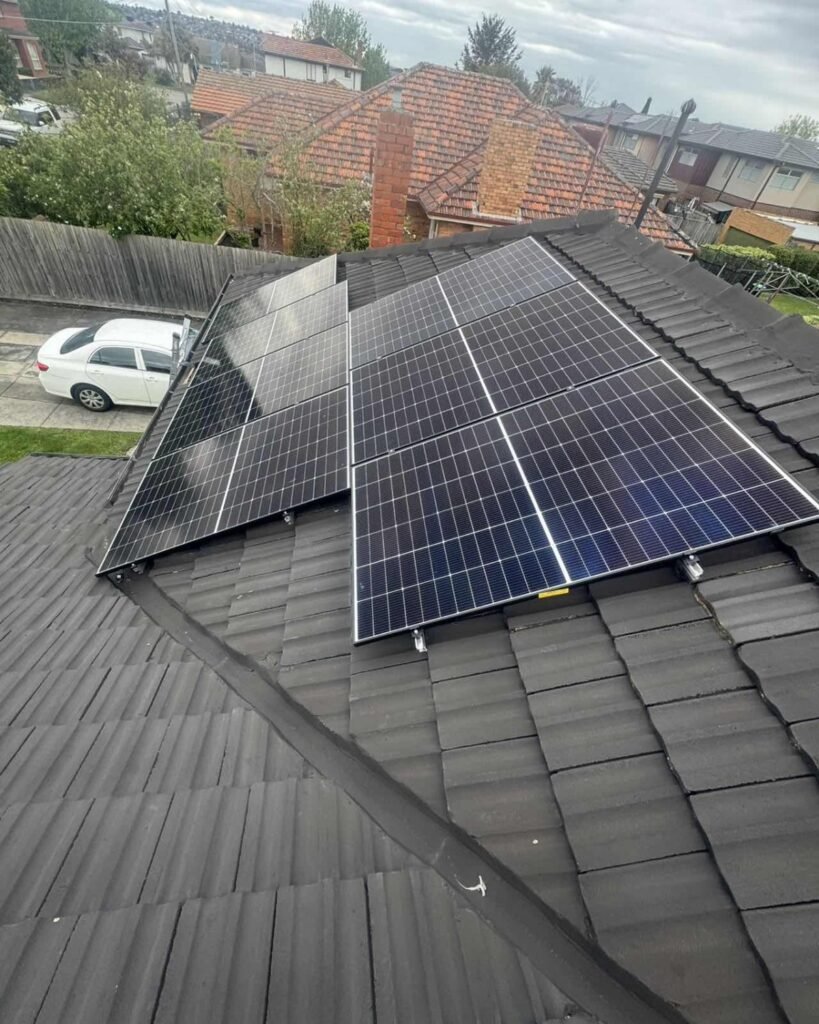
Solar stopped being an environmental gesture some time ago. At current electricity prices it is an infrastructure decision with a payback period, and like any infrastructure decision it is worth doing once, properly.
The variable that decides whether a system earns its money is not panel count. It is how much of what you generate you actually use yourself.
Self-consumption is the whole game
Every kilowatt-hour you consume from your own roof is worth the full retail rate you would otherwise have paid. Every kilowatt-hour you export is worth the feed-in tariff, which is a fraction of that.
So the honest question at design time is not “how big a system fits on the roof” but “what is this household actually doing between 9am and 4pm”. A house with someone home during the day, a pool pump, or a heat pump hot water system running on a daytime timer behaves completely differently from an empty house on weekdays.
We ask those questions before we propose a size. It is why our recommended system is sometimes smaller than what you have been quoted elsewhere.
System sizes
- 6.6kW — the common starting point for a typical household, and usually the best value per dollar installed
- 10kW — larger homes, higher daytime usage, or households planning to electrify hot water and heating
- 13kW and above — large roofs with high consumption, or where an EV and a battery are part of the plan
Export limits imposed by your distributor can cap what you are permitted to send back to the grid, and that cap varies by network area — and differs between Victorian and NSW distributors. We check yours before designing the system rather than after.
Solar incentives
Solar sits mainly under the federal scheme rather than the state efficiency schemes. Eligible systems generate Small-scale Technology Certificates under the Renewable Energy Target, administered nationally by the Clean Energy Regulator, and that support applies in Victoria and New South Wales alike.
One timing point worth knowing: the number of certificates a system generates is calculated partly from the years remaining in the scheme, which ends in 2030, and that multiplier steps down every January. The same system installed next year generates fewer certificates than it does this year. We will put the current figure on your quote rather than publishing a number here that dates.
If you are adding a battery at the same time, additional incentives may apply — see solar batteries.
What goes on the roof
Clean Energy Council approved panels and inverters, mounted on certified racking, installed by accredited installers. We will tell you which brands we are proposing, what the product and performance warranties actually cover, and where the trade-offs sit between the tiers.
Roof condition matters too. If your tiles are brittle or the roof is due for work in the next few years, we will say so before we put a system on it — it is far cheaper to hear that at quote stage than to pay for a removal and refit later.
Modelling, not brochures
You get a written proposal with the proposed layout, the expected annual generation for your orientation and pitch, an estimate of self-consumption against your actual bill, and the resulting payback. Where the numbers are uncertain, we say which assumption is doing the work.
Install day
Most residential installs are completed in a single day. Grid connection paperwork is lodged with your distributor, the meter reconfiguration is arranged, and we walk you through monitoring so you can see what the system is doing from day one.
Thinking about a battery as well? Read our solar battery page first — it is not always the right second step, and we will tell you when it is not.
Call 1300 163 177 to get a system designed around your bill.