
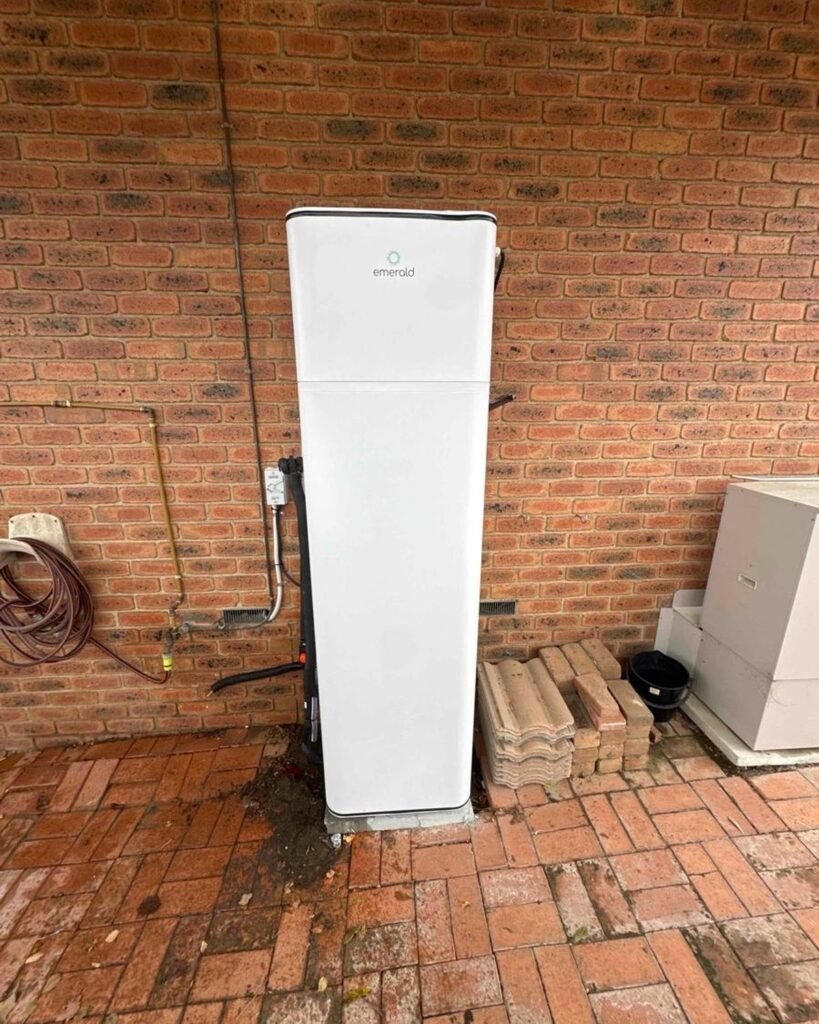
A heat pump hot water system does not make heat. It moves it — pulling warmth out of the surrounding air and transferring it into your tank. That single difference is why it runs on roughly a third to a quarter of the electricity a conventional electric storage tank needs to heat the same water.
For most households still running an old electric or gas unit, it is the single largest cut available on a power bill, and it is the upgrade the state efficiency schemes support most heavily in both Victoria and New South Wales.
What we install
All-in-one systems
Compressor and tank in a single unit, sitting where your old system sat. The simplest swap, the smallest footprint, and the right answer for the majority of homes we visit. Common sizes run from 170L for smaller households up to 300L for families of five or more.
Split systems
The compressor separates from the tank, which lets us site each component where it actually works best. Useful where access is tight, where noise matters because a bedroom window is close, or where the tank needs to stay in an internal or under-cover position.
What it costs to run
A typical family of four replacing an electric storage tank saves somewhere between $300 and $900 a year. That range is wide on purpose — the figure moves with your tariff, how many people shower daily, whether you have solar generating through the middle of the day, and how well the tank is positioned.
We will not quote you an industry average. We ask what you are currently paying, look at the system being replaced, and give you a number built on your own usage. If the payback does not stack up for your household, we will tell you that too.
Rebates on heat pump hot water
Hot water is the most heavily supported upgrade in both states we install in, but the schemes are different.
In Victoria, the Victorian Energy Upgrades programme creates Victorian Energy Efficiency Certificates for replacing electric or gas hot water with a heat pump. In New South Wales, the Energy Savings Scheme covers the same upgrade and creates Energy Savings Certificates. Eligible systems in both states can also attract federal Small-scale Technology Certificates.
Eligibility depends on your property, the system being replaced and whether an upgrade has already been claimed at that address. We check it before quoting, so the price you see already has the discount applied. Green Energy Savers works through accredited partners — an Accredited Person in Victoria, an Accredited Certificate Provider in New South Wales — who create and lodge the certificates. You are not left chasing paperwork or waiting on a refund.
See rebates and eligibility for how each scheme works.
The install itself
Half a day for a standard replacement. Our licensed installers decommission and remove the old unit, prepare the base, set and plumb the new system, complete the electrical connection and pressure test the installation before handover.
- Old system rendered inoperable and removed from site
- Electrical work certified, with a Certificate of Electrical Safety issued
- Plumbing compliance certificate provided
- Compliance photography documented for the upgrade claim
- Controller set up and demonstrated before we leave
In almost every case you have hot water again the same day.
Is a heat pump right for your home?
It usually is, but not always. Heat pumps work best with reasonable airflow around the unit and a sensible place to put it. Very tight side passages, heavily enclosed courtyards or a position hard against a neighbouring bedroom wall all change the recommendation — sometimes to a split configuration, occasionally to a different solution entirely.
That assessment takes one visit and costs you nothing. Call 1300 163 177 or request a quote and we will tell you honestly what suits the property.