
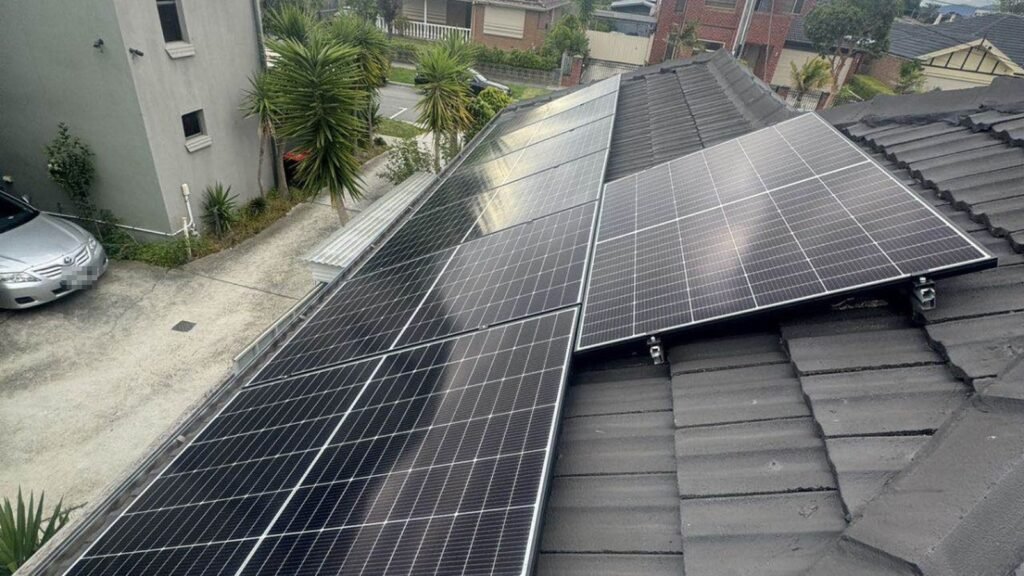
For a business with a daytime load, solar is one of the few capital purchases where the return is both predictable and immediate. You are replacing a recurring operating cost with an asset, and the load profile of most commercial sites — running hardest when the sun is up — makes the self-consumption case far stronger than it is for a typical home.
Sites we work on
- Warehouses and distribution facilities
- Manufacturing and workshops
- Medical and allied health clinics
- Retail, hospitality and childcare
- Offices and strata-managed commercial buildings
System sizes typically run from 10kW through to 100kW and beyond, depending on roof area, load and the constraints your distributor places on export. We install across Victoria and New South Wales.
Design starts with your load profile
We work from interval data rather than annual totals. A site with a hard morning peak needs a different array orientation from one that runs flat across the day, and a site with heavy refrigeration or compressed air behaves differently again.
That data also determines whether export is worth pursuing at all. On many commercial sites the optimal system is sized to self-consumption and deliberately capped, because the network constraint or the export rate makes the extra capacity unprofitable.
Incentives for commercial systems
Systems under 100kW generate Small-scale Technology Certificates under the federal Renewable Energy Target. Larger systems fall under Large-scale Generation Certificates instead, which work on a different basis — generation metered over time rather than a single upfront calculation.
Depending on the site and the state, other upgrades carried out alongside solar may qualify separately: commercial hot water, air conditioning and refrigeration activities sit under the Victorian Energy Upgrades programme in Victoria, and under the Energy Savings Scheme and Peak Demand Reduction Scheme in New South Wales.
We identify what applies to your site and show it in the financial model rather than leaving value on the table. See rebates and eligibility for how the schemes differ.
The structural and electrical reality
Commercial roofs bring engineering questions that residential roofs do not: structural loading, sheet condition and fixing type, penetration detailing and warranty implications, switchboard capacity, and whether your main switchboard can accept the inverter connection without an upgrade.
We assess all of it before quoting. A quote that ignores a needed switchboard upgrade is not a cheaper quote — it is an incomplete one, and the difference surfaces mid-project.
The financial case, laid out
Your proposal includes the modelled generation, the self-consumption assumption and where it came from, the effect on your demand and energy charges separately, the payback period, and the internal rate of return. Available incentives are identified and applied.
We also state what would break the model — a tariff change, a shift in operating hours, a tenancy change — so you can judge the risk yourself rather than taking the headline number on faith.
Delivery
Licensed and accredited trades, site-specific SWMS and inductions, works scheduled around your operating hours, and grid connection managed with your distributor from application through to approval. Commissioning includes monitoring set up so you can see performance per string from day one.
Start with a desktop assessment
Send us twelve months of bills and your address. We will come back with an indicative system size, a generation estimate and a payback range before anyone visits the site.
Call 1300 163 177 or email info@greenenergysavers.net.